
The timeless principles of medical publishing

Having recently started my career in medical communications, I’ve been diving into the history of the industry. I have just finished reading Thomas Morris’s book, The Mystery of the Exploding Teeth, which explores fascinating stories from the history of medicine. One of the earliest medical journals mentioned in the book caught my attention, and since my work today focuses largely on reading and writing for these journals, I decided to dig a little deeper into the evolution of medical publishing.
Medical Essays and Observations, first published in 1733 in Edinburgh, was the first sustained English-language medical journal. This journal marked a turning point in the dissemination of medical knowledge and significantly influenced modern medical publishing. The founding society aimed to ease the burden on busy medical practitioners by providing a platform for short-form clinical and pathological case reports, rather than full books. These reports, published yearly, consolidated information from multiple practitioners about medical practices, improvements and discoveries.
Over the last 300 years, the medical publication industry has evolved significantly, yet some principles established at the very beginning remain surprisingly modern. In the preface of the first volume of Medical Essays and Observations, the editor, Alexander Monro primus (not to be confused with his son, Alexander Monro secundus, or his grandson, Alexander Monro tertius), candidly addressed challenges still relevant today. These include the difficulty for professionals to stay up to date with increasing amounts of information and the tendency of authors to exaggerate their successes and hide mistakes. Monro outlined essential qualities for authors that we still aspire to today: sagacity and knowledge to guard against errors, accuracy to omit no essential circumstance, and candour to conceal nothing material.
Medical Essays and Observations also laid the foundations of the peer-review process, which is standard practice today. Articles were evaluated by anonymous society members most familiar with the subject matter. While today’s reviewers are more independent, it’s amazing how much of this early practice has continued and evolved.
The medical publishing industry has massively expanded, but as medical writers, we still strive to abide by similar principles to those laid down in the beginning. Today, we adhere to professional standards such as the International Committee of Medical Journal Editors (ICMJE) recommendations, the Good Publication Practice (GPP) guidelines, and the Consolidated Standards of Reporting Trials (CONSORT) guidelines. These guidelines are the cornerstones of ethical and professional standards in medical publishing, especially for clinical trial publications. Our role as medical writers is to uphold these standards, ensuring the accuracy and transparency of medical information so that knowledge continues to advance and healthcare professionals stay informed.
Having learned a little about the history, I’m keen to see how the industry will continue to grow and excited to be a part of it.
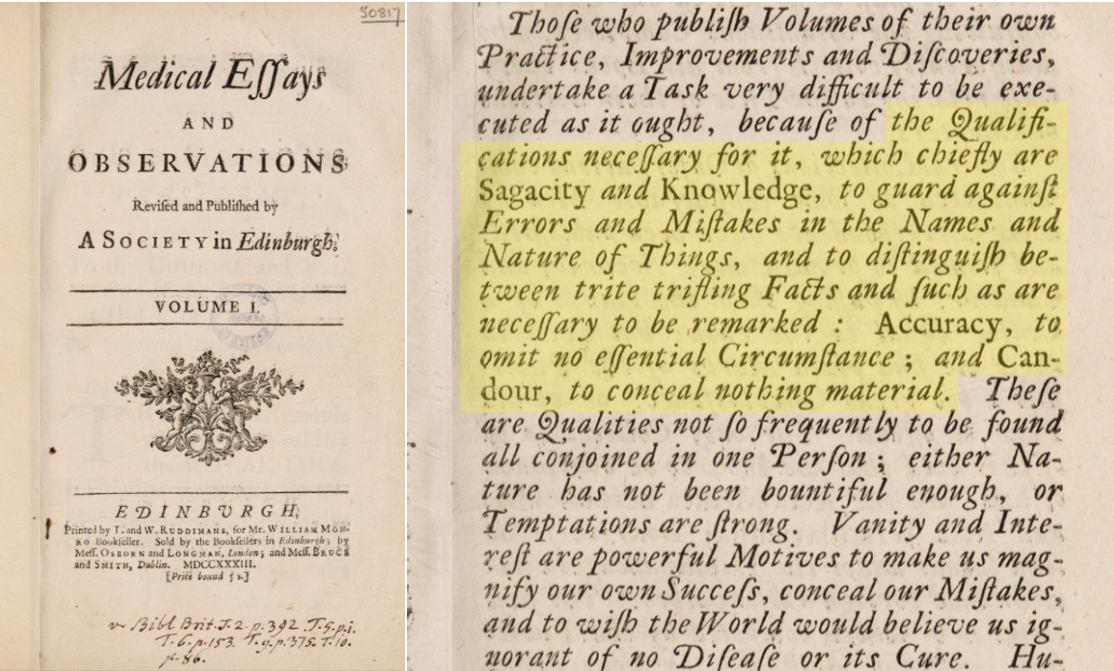
Philosophical Society of Edinburgh. Medical Essays and Observations. Volume 1. 1733. Edinburgh, United Kingdom: Wellcome Library. Available at: https://archive.org/details/s5id13407060. Cover page (left) and preface extract (right). Highlighted section outlines the necessary qualities of authors in medical publishing.